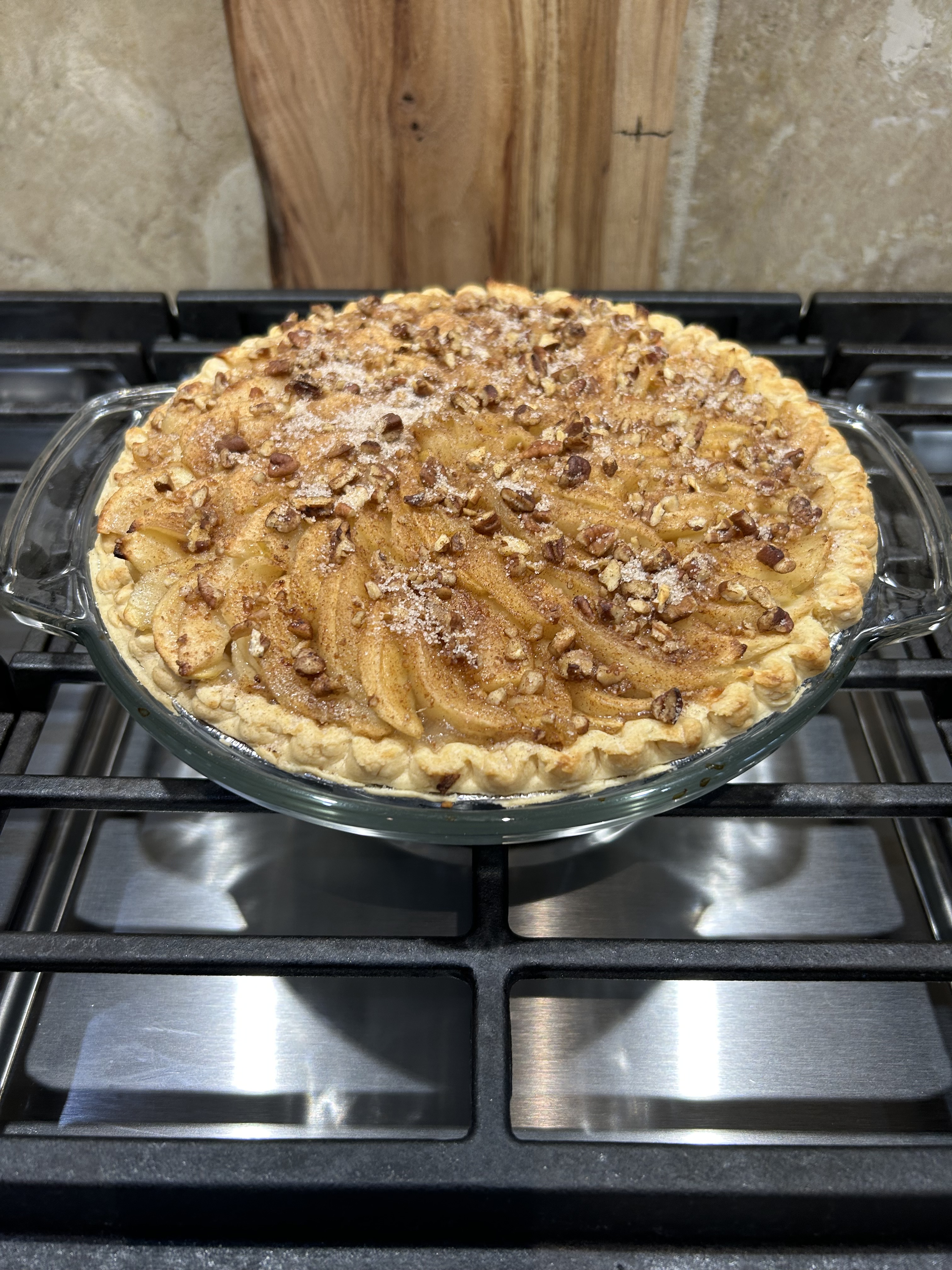
I helped peel and slice the apples. The retiree did the rest.
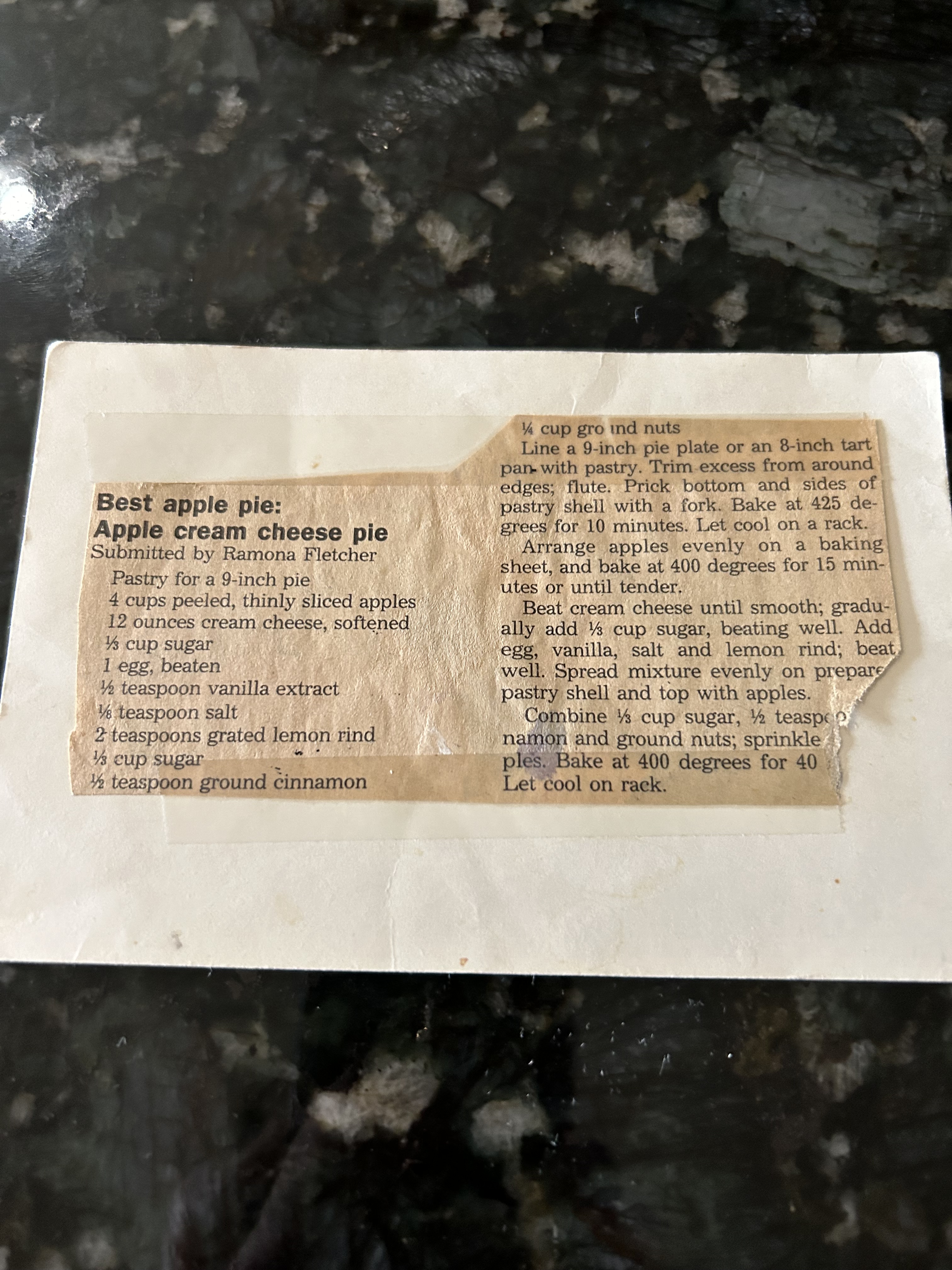
Apple Cream Cheese Pie. It’s like an apple pie and a cheesecake got married and had a kid.

A food memoir of weight loss, family recipes, and strategies for staying healthy in your 70's and beyond
I helped peel and slice the apples. The retiree did the rest.
Apple Cream Cheese Pie. It’s like an apple pie and a cheesecake got married and had a kid.
Half a cup of blueberries a day improved the average participant’s language skills, improved their short-term memory, and enhanced their decision-making, planning, and organizational skills. Scientists Just Discovered That Eating Blueberries Will Make You Smarter and ‘Significantly’ Improve Your Memory — https://www.inc.com/jeff-haden/scientists-just-discovered-that-eating-blueberries-will-make-you-smarter-significantly-improve-your-memory.html
So I suppose not eating blueberries for most of my life was the main driver behind my impaired language skills, memory and decision making.
I wonder if the effects are dose dependent?
Sorry Hon, I ate all the blueberries. Again.
After a session at the Y with the resistance machines I stopped at a grocery store to pick up some cabbage for the slaw topping for black bean tacos. See Crispy Black Bean Tacos with Feta and Honey-Lime Cabbage Slaw. Myron was working that day so I had to stop and visit. Myron is an Old Guy who works at the store 1-2 days a week handing out samples. Somewhere in the conversation I mentioned I would be turning 70 in a few months and that I was for sure older than he (nod, nod, wink, wink).
“Oh no you’re not. I’m going to be 80 in a few months.”
“You look great. You must be one of those vegans!”
Myron got a good laugh out of that comment. His face got serious for a moment. Then he said,
“No, not me. I’m not vegan. And I happen to be addicted to chocolate peanut butter cups.”
“Must be the anti-oxidants in the chocolate and protein in the peanut butter.”
It’s always interesting to discover how some of us tend to thrive in our later years.
Chocolate peanut butter cups! I forgot to mention to this spry near 80 year old that the most popular brand of his addiction now makes a vegan version.
Sorry, I got off topic. Here’s the link to more Blue Zone Stuff.
6 Benefits of Spending Time with Grandchildren https://www.bluezones.com/2024/08/6-benefits-of-spending-time-with-grandchildren/
Myron also square dances and watches his grandchildren several days a week.
I’m not about to begin square dancing but more chocolate peanut butter cups sounds pretty good to me.

Yup, the second time in two weeks.
My near-retirement years are sweet and hopefully not too fattening.
See What Retirees Do With Their Time #1 for the recipe.
Better yet see Strawberry Mousse for the recipe. 2017! I totally forgot I posted the recipe at some distant time in the past. Yup, I’m embarrassed.

Tommy Lundberg, an exercise researcher at the Karolinska Institute in Solna, Sweden, and the author of The Physiology of Resistance Training, says that strength training is far more important than most people realize.
“You get improved glucose control, especially if you have Type 2 diabetes,” he says. “You feel better —which is a very important effect, as it can reduce stress levels — and you typically get better sleep. As you age, it helps you function better so you can carry out your daily activities for a longer period of time. It also helps reduce your risk of falls.” https://www.newsmax.com/health/health-news/strength-training-resistance-longevity/2024/01/24/id/1150856/
Food is another key component of healthy living in blue zones, says Buettner. People there tend to consume unprocessed foods, beans, legumes, fruits, and vegetables—often following traditional recipes that have been passed down through generations. That style of eating is good for heart and cognitive health, says Linda Hershey, MD, PhD, FAAN, professor of neurology at the University of Oklahoma Health Sciences Center in Oklahoma City. “Numerous high-quality studies support the benefits of the MIND, DASH, and Mediterranean diets, which emphasize green leafy vegetables, fruits, beans, nuts, fish, poultry, oil, and whole grains, and discourage fried food, processed meat, snack foods, and sweets,” Dr. Hershey says.
“Blue Zones” Author Dan Buettner Shares the Secrets to a Long and Healthy Life — https://www.brainandlife.org/articles/author-dan-buettner-shares-secrets-to-long-healthy-life
Researchers used the portfolio diet score to rank the participants’ consumption of plant proteins, nuts and seeds, viscous fiber, phytosterols and plant sources of monounsaturated fatty acids. After up to 30 years of follow-up, those with the highest portfolio diet score had a 14% lower risk of coronary heart disease and stroke compared to those with the lowest score. The findings were published Wednesday in the American Heart Association journal Circulation.
“We’re always looking at ways to reduce the risk of heart disease, and one effective way to do that is to lower blood cholesterol levels, particularly LDL cholesterol,” said Dr. Kristina Petersen, an associate professor of nutritional sciences at Penn State in University Park, Pennsylvania.
Petersen, who was not involved in the research, is well-versed in how diets can affect heart health. She co-authored an AHA scientific statement published in April that scored 10 popular diets for their heart-health benefits. The Dietary Approaches to Stop Hypertension – or DASH – diet was the only eating pattern to get a perfect score, with the Mediterranean and pescetarian diets rounding out the top three. The portfolio diet was excluded from the assessment “because it’s not particularly common,” she said.
Ever heard of the portfolio diet? — https://www.heart.org/en/news/2023/10/25/ever-heard-of-the-portfolio-diet-it-may-lower-risk-for-heart-disease-and-stroke
“It’s really what they’re not doing. They’re not doing anything consciously, and there’s where we get it wrong,” Buettner said. “We think we can resolve to get on the right diet, the right exercise program, supplement plan, superfoods, and get healthier. But it never works.”
Buettner said that the “superagers” are often walking outside, having spontaneous conversations with the people they bump into, having a smaller dinner, and eating mostly a whole food, plant-centric diet.
A look inside the United States’ first-ever certified “Blue Zone” located in Minnesota — https://foodfactsandfads.com/2024/02/04/6306/
Remember, Eat More Plants.
Also Research Reveals One Simple Habit That Promotes Longevity AND Provides Extra Income in Retirement

The Role of Diet and Dietary Patterns in Parkinson’s Disease — Nutrients 2022, 14(21), 4472; https://doi.org/10.3390/nu14214472
A few changes in food choices here and there can’t hurt and may just help.
I was mystified. Butter beans — or lima beans, as I grew up calling them in the Midwest — are the most banal of ingredients, a boring bean relegated to the darkest corner of every home cook’s pantry. Why, then, were food influencers drowning them in luxurious sauces, crisping them up as a crouton substitute, and braising them as if they were a fine cut of meat? What the heck was going on?
Beans, broadly speaking, are having a moment. The dry bean market is expected to grow to $8.7 billion by 2028, while the canned bean industry raked in $5.65 billion in 2023 and is projected to be worth a whopping $15.5 billion by 2033, according to the market research firm Fact.MR.
How Butter Beans Went From Gross to Glamorous — https://www.eater.com/24008145/why-are-butter-beans-so-popular
Beans are cheap and nutritious. More people will be incorporating this staple into their diets because they are unable to afford the more expensive foods.
It’s not the vegan/vegetarian/let’s save the world movement. It’s basic economics.

