Eat More Protein at Breakfast

A year-long study of the dietary habits of 9,341 Australians has backed growing evidence that highly processed and refined foods are the leading contributor of rising obesity rates in the Western world.

The new study, in the latest issue of the journal Obesity conducted by the University of Sydney’s Charles Perkins Centre (CPC), was based on a national nutrition and physical activity survey undertaken by the Australian Bureau of Statistics (ABS), and further backs the ‘Protein Leverage Hypothesis’. 

Participants with a lower proportion of protein than recommended at the first meal consumed more discretionary foods – energy-dense foods high in saturated fats, sugars, salt, or alcohol – throughout the day, and less of the recommended five food groups (grains; vegetables/legumes; fruit; dairy and meats). Consequently, they had an overall poorer diet at each mealtime, with their percentage of protein energy decreasing even as their discretionary food intake rose – an effect the scientists call ‘protein dilution’. 

“The results support an integrated ecological and mechanistic explanation for obesity, in which low-protein, highly processed foods lead to higher energy intake in response to a nutrient imbalance driven by a dominant appetite for protein,” said Professor Raubenheimer. “It supports a central role for protein in the obesity epidemic, with significant implications for global health.”

Study confirms that processed foods key to rising obesity — https://www.sydney.edu.au/news-opinion/news/2022/11/08/processed-foods-key-to-rising-obesity-study-finds-.html

Beans for breakfast anyone? Eggs?

Link to the original study Macronutrient (im)balance drives energy intake in an obesogenic food environment: An ecological analysis – https://onlinelibrary.wiley.com/doi/10.1002/oby.23578

Earlier posts on the obesogenic food environment:

More on the Obesogenic Environment

Obesogenic food environment

More on the Obesogenic Environment

In an editorial in Obesity, Corkey discusses the many different theories explaining why obesity continues to increase despite best efforts at controlling weight gain in this environment, including increased availability and marketing of high-calorie and high-glycemic-index foods and drinks, larger food portions, leisure time physical activities being replaced with sedentary activities such as watching television and use of electronic devices, inadequate sleep, and the use of medications that increase weight.

According to Corkey, all of these purported explanations assume an environmental cause that is detrimental to the organism involved, (humans).

Boston University School of Medicine. “Finding the solution to obesity: Culinary medicine, emerging evidence-based field, ID’d as early intervention.” ScienceDaily. http://www.sciencedaily.com/releases/2022/11/221102115527.htm (accessed November 3, 2022)

Diseases related to obesity correlate with both the extent and duration of obesity. This suggests that diseases related to obesity will also increase more rapidly owing to the younger onset and more severe forms of the disease.

Barbara E. Corkey, Caroline M. Apovian. “En attendant Godot”: Waiting for the answer to obesity and longevity. Obesity, 2022; 30 (11): 2105 DOI: 10.1002/oby.23462

I have a growing sense of urgency to finish writing my future best seller.

I just have to figure out how to describe what I know in language simple enough for everyone to understand.

More on What Your Ancestors Ate

People have been working with the Hadza for decades now, so we have these long-term records, papers published from 30 or 40 years ago up through to today. We can understand from those data how variable diet can be: We’ve seen how the amount of meat changes with the seasons. It’s more skewed toward plants during wet seasons, for example. We’ve seen how different plant species, such as berries and tubers, contribute to diet in different ways over the course of a year. We’ve also learned that honey is a really big part of their diet…

Humans evolved to be adaptable. We are very much dependent on learning and developing these complex hoarding strategies to survive. And different people follow different paths. I think this adaptability is part of this whole package of how we live as a species. We’re built to be flexible. And flexibility means diversity…

I think the one thing that they never have in a hunter-gatherer diet is the heavily processed foods that we are surrounded with. In processed foods, you get these combinations of sugars, salts and fats that never occur in nature. You take out a lot of things like fiber and protein that make you feel full, and put in a lot of things that make your brain’s reward systems light up, like flavoring. Processed foods seem to be a big driver of obesity.

Our Ancestors Ate a Paleo Diet, With Carbs – https://www.smithsonianmag.com/science-nature/our-ancestors-ate-a-paleo-diet-with-carbs-180980901/

Remember, You Are What Your Ancestors Ate.

Be an Omnivore.

Sugar disrupts microbiome, eliminates protection against obesity and diabetes (in mice)

Photo by Nishant Aneja on Pexels.com

After four weeks on the diet, the animals showed characteristics of metabolic syndrome, such as weight gain, insulin resistance, and glucose intolerance. And their microbiomes had changed dramatically, with the amount of segmented filamentous bacteria — common in the gut microbiota of rodents, fish, and chickens — falling sharply and other bacteria increasing in abundance.

Sugar disrupts microbiome, eliminates protection against obesity and diabetes — Columbia University Irving Medical Center. “Sugar disrupts microbiome, eliminates protection against obesity and diabetes.” ScienceDaily. http://www.sciencedaily.com/releases/2022/08/220829194721.htm (accessed September 7, 2022)

Here’s the link to the original study – https://www.cell.com/cell/fulltext/S0092-8674(22)00992-8?_returnURL=https%3A%2F%2Flinkinghub.elsevier.com%2Fretrieve%2Fpii%2FS0092867422009928%3Fshowall%3Dtrue

I’m cleaning up my saved drafts for this blog and apologize up front if I’ve already posted this. But since this post was in my draft folder I’m pretty sure I haven’t already posted this. I need to delete some drafts I’ve kept around since 2018.

2018!!!

Exercise is Not Essential for Weight Loss. It is Vital for Your Health — Damon Ashworth Psychology

Alongside nutrition and sleep, exercise is one of the three pillars of our health. Before coming up with a realistic and sustainable plan, let’s see what types of exercise are most recommended and how much we should try to do each day or each week. Walking – is there anything to the 10,000 steps recommendation? […]

If you want to lose weight, please remember that nutrition, and not exercise, is the best way to do this. The type, amount, and timing of when you eat and drink are more important for how much weight and fat you lose than how active you are.

Exercise is Not Essential for Weight Loss. It is Vital for Your Health — Damon Ashworth Psychology

Building new habits takes time. My typical morning routine is bathroom, shower, dry off (don’t forget this step), coffee and either read or write before starting my work day. Today I’m starting a new routine which hopefully becomes habit. Coffee AND resistance training (shower later).

Another morning habit I didn’t realize existed until today was my morning dopamine hit from likes and page views. What? Someone from Down Under liked my Resistance is Not Futile post. And followed me! Naturally I had to follow back and reblog which is not cheating or stealing someone else’s hard work.

Thank you Dr. Ashworth. But more importantly THANK YOU for Josh Giddey. https://www.nba.com/player/1630581/josh-giddey

Resistance is Not Futile

Photo by Anna Shvets on Pexels.com

A 2022 study review from Japanese researchers linked “muscle-strengthening activities” to a 15% lower risk of dying. Resistance exercise was also linked to a lower risk of cardiovascular disease (17%), cancer (12%), and diabetes (17%)…

For longevity, strength training seems to be especially effective for older adults, says Tufts University professor Roger Fielding, PhD, who’s been studying the role of exercise in the aging process since the early 1990s…

The maximum longevity benefit comes from one or two resistance exercise sessions a week totaling 30 to 60 minutes.

How Strength Training Can Help You Live Longer – Medscape – Sep 02, 2022 — https://www.medscape.com/viewarticle/980170?src=rss#vp_1

I got motivated. I changed my morning coffee routine to include a few minutes of resistance work. My habit of going to the Y for resistance work ended shortly after Covid hit our shores. Since then I’ve accumulated some free weights and a couple of resistance bands. I used to have a smaller band that snapped during an exercise session and no it didn’t hurt (much). Recently I bought some ankle weights for my soon to be copyrighted Old Man Chair Leg Lift routine. Now I can replicate all of the exercises I used to do at the gym. With the convenience of working from home and not having to get out to the Y hopefully I can maintain this new routine and turn it into a habit.

Of course I converted “one or two resistance exercise sessions a week totaling 30 to 60 minutes” to 12 minutes a day, five days a week.

Boom.

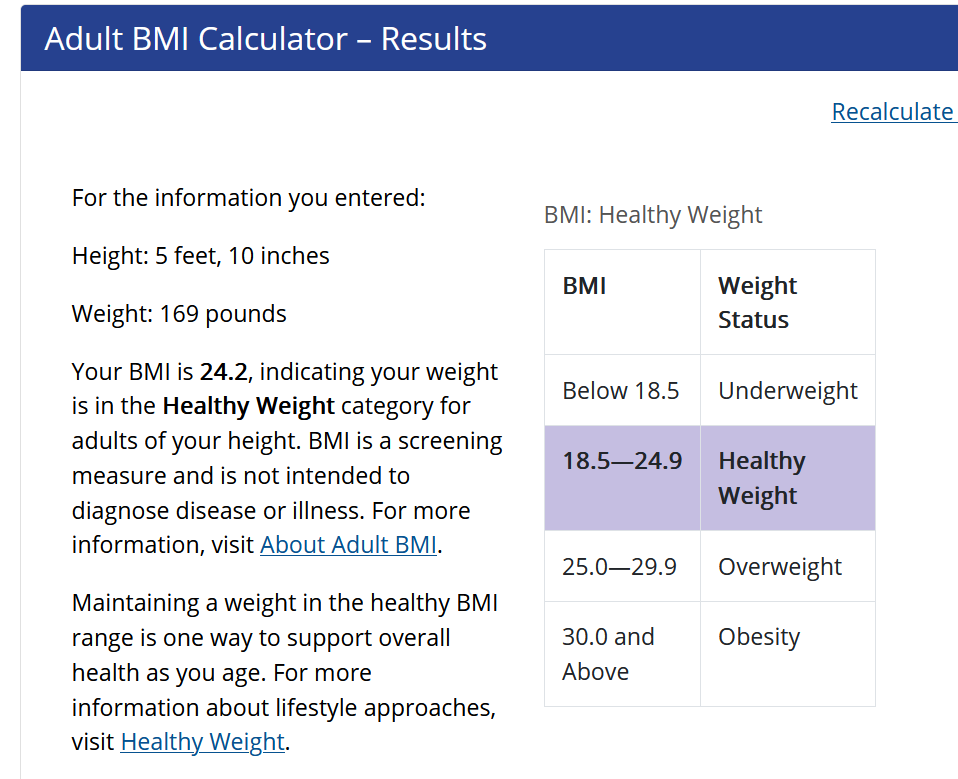
Remember it’s not just about diet and BMI. But since you asked…

Still 200 pounds less than my max.

It’s a three day weekend. Maybe I’ll work on my Future Best Seller.

You Are What Your Ancestors Ate

Humans also vary in their ability to extract sugars from starchy foods as they chew them, depending on how many copies of a certain gene they inherit. Populations that traditionally ate more starchy foods, such as the Hadza, have more copies of the gene than the Yakut meat-eaters of Siberia, and their saliva helps break down starches before the food reaches their stomachs.

These examples suggest a twist on “You are what you eat.” More accurately, you are what your ancestors ate. There is tremendous variation in what foods humans can thrive on, depending on genetic inheritance. Traditional diets today include the vegetarian regimen of India’s Jains, the meat-intensive fare of Inuit, and the fish-heavy diet of Malaysia’s Bajau people. The Nochmani of the Nicobar Islands off the coast of India get by on protein from insects. “What makes us human is our ability to find a meal in virtually any environment,” says the Tsimane study co-leader Leonard…

In other words, there is no one ideal human diet. Aiello and Leonard say the real hallmark of being human isn’t our taste for meat but our ability to adapt to many habitats—and to be able to combine many different foods to create many healthy diets. Unfortunately the modern Western diet does not appear to be one of them.

The Evolution of Diet — https://www.nationalgeographic.com/foodfeatures/evolution-of-diet/

Food for thought (pun intended).

This article is worth reading even if you remember just one concept.

There is no one ideal human diet.

Make Homemade Veggie Burgers

Krista Navin has been a vegetarian since she was a teen, and says these imitation meats have been creeping onto more menus. It really hit home when Burger King replaced its veggie patty — made by vegetarian stalwart brand Morningstar Farms — with the Impossible Whopper. “I find those types of burgers uniquely off-putting,” Navin says. “I think they have actually done a really good job making them like the real thing and that is exactly the thing I don’t want.”

It’s Time to Put Actual Veggies Back Into Veggie Burgers — https://www.eater.com/23274496/veggie-burger-vegetarian-should-be-made-from-vegetables

Results from the Brazilian Longitudinal Study of Adult Health (ELSA-Brasil), which included participants aged 35 and older, showed that higher intake of UPF was significantly associated with a faster rate of decline in both executive and global cognitive function.”Based on these findings, doctors might counsel patients to prefer cooking at home [and] choosing fresher ingredients instead of buying ready-made meals and snacks,” co-investigator Natalia Goncalves, PhD, University of São Paulo Medical School, Brazil, told Medscape Medical News.“Participants who reported consumption of more than 20% of daily calories from ultraprocessed foods had a 28% faster rate of global cognitive decline and a 25% faster decrease of the executive function compared to those who reported eating less than 20% of daily calories from ultraprocessed foods,

More Evidence Ultraprocessed Foods Detrimental for the Brain – Medscape – Aug 01, 2022. https://www.medscape.com/viewarticle/978365?src=rss

UPF consumption was associated with worse performance in Animal Fluency among older people without pre-existing diseases. Decreasing UPF consumption may be a way to improve impaired cognition among older adults.

Association between ultra-processed food consumption and cognitive performance in US older adults: a cross-sectional analysis of the NHANES 2011–2014 — https://link.springer.com/article/10.1007/s00394-022-02911-1

“You used to eat those commercially prepared veggie burgers.”

“I don’t eat them anymore. It’s better to make your own.”

Faithful followers know what happened during the inferno summer of 2022 because of my earlier post on Spinach, Mushrooms and Onion. I’m still working feverishly to reduce the number of packages of frozen vegetables to make room for other items. The other day I used up a package of frozen spinach and about a cup and a half of cooked chickpeas to make Chickpea and Spinach Burgers.

Yup, that’s right. No recipe. The Boss said,

“Go ahead and toss all of the spinach in the mix.”

So I did. Instead of Chickpea and Spinach Burgers I ended up making Spinach Burgers with a Small Spattering of Chickpeas Somewhere in the Mix.

I promise to post if and when I’m totally happy with the results.

Eat Eggs

Eggs are a rich source of dietary cholesterol, but they also contain a variety of essential nutrients. There is conflicting evidence as to whether egg consumption is beneficial or harmful to heart health. A 2018 study published in the journal Heart, which included approximately half a million adults in China, found that those who ate eggs daily (about one egg per day) had a substantially lower risk of heart disease and stroke than those who ate eggs less frequently*. Now, to better understand this relationship, the authors of this work have carried out a population-based study exploring how egg consumption affects markers of cardiovascular health in the blood.

eLife. “How eating eggs can boost heart health.” ScienceDaily. http://www.sciencedaily.com/releases/2022/05/220524124839.htm (accessed May 25, 2022).

Results – Egg consumption was associated with 24 out of 225 markers, including positive associations for apolipoprotein A1, acetate, mean HDL diameter, and lipid profiles of very large and large HDL, and inverse associations for total cholesterol and cholesterol esters in small VLDL. Among these 24 markers, 14 were associated with CVD risk. In general, the associations of egg consumption with metabolic markers and of these markers with CVD risk showed opposite patterns.

Conclusions – In the Chinese population, egg consumption is associated with several metabolic markers, which may partially explain the protective effect of moderate egg consumption on CVD.

Pan et al. investigated associations of self-reported egg consumption with plasma metabolic markers and these plasma metabolic markers with the risk of cardiovascular diseases. In general, there was some impact on metabolic markers which could protect against CVD. The paper will interest scientists in the field of nutritional epidemiology.

Association of egg consumption, metabolic markers, and risk of cardiovascular diseases: A nested case-control study — https://elifesciences.org/articles/72909

To review the study shortcomings hop over to the full study and read the editorial decision letter.

Stanford Center on Longevity – Diet Research Update

There are a growing number of diet choices that promote healthier eating. Common among several of the most-well known diets (e.g., paleo, Mediterranean, vegan), is an emphasis on the consumption of plant-based foods (sometimes alongside animal protein, sometimes without), and the avoidance of added sugar, refined grains, and ultra-processed foods. There is increasing evidence that consuming more plant-based foods is beneficial to our overall health, especially our immune system health. There are also data indicating that consuming more plant protein than animal protein is healthy for both ourselves and the environment.

Diet — https://longevity.stanford.edu/research-update-on-diet/

Reality check below –

We have a lot of work to do.

Do your part by reading the entire research update and sharing the love.