Lead author Yanni Papanikolaou and colleagues analyzed data from the National Health and Nutrition Examination Survey’s What We Eat in America program to study how often U.S.-based adults consume beans. In their analyses, they focused on how often Americans consumed white and red kidney beans, black beans, chickpeas, and pinto beans. The researchers observed that adults who routinely consumed these beans had improved ratios of polyunsaturated fatty acids, monounsaturated fatty acids, and saturated fatty acids compared to those who did not consume beans. Those who ate beans also consumed 30% more fruits and 20% more vegetables. Higher Intake Of Beans Linked To More Nutritious Diet — https://www.forbes.com/sites/anuradhavaranasi/2024/06/11/higher-intake-of-beans-linked-to-more-nutritious-diet/
It has long been thought that meat played an important role in the diet of hunter-gatherers before the Neolithic transition. However, due to the scarcity of well-preserved human remains from Paleolithic sites, little information exists about the dietary habits of pre-agricultural human groups. A new study challenges this notion by presenting compelling isotopic evidence of a strong preference for plants among 15,000-year-old hunter-gatherers from Morocco. This is the first time a significant amount of plant consumption has been measured for a pre-agricultural population, shedding new light on the dietary practices of ancient human societies. More plants on the menu of ancient hunter-gatherers — https://www.mpg.de/21865602/more-plants-on-the-menu-of-ancient-hunters-gatherers
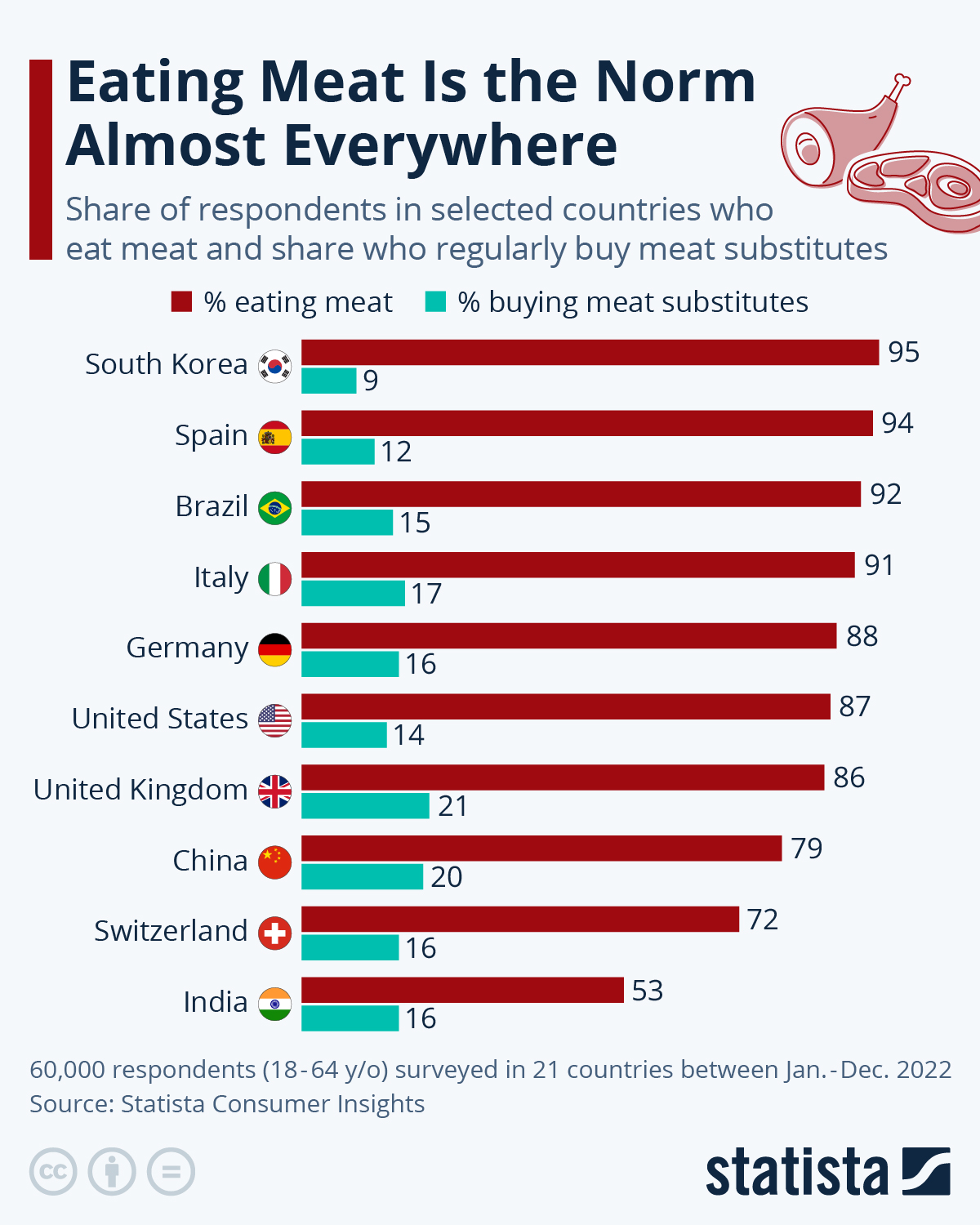
On average, 86 percent of people surveyed for Statista’s Consumer Insights in 21 countries said that their diet contained meat – highlighting that despite the trend around meat substitutes and plant-based products, eating meat remains the norm almost everywhere in the world. To satisfy the world’s hunger for meat, 340 million tons of it were produced globally in 2021. Because meat consumption typically increases as countries grow wealthier, that number has been rising.
I haven’t been writing much lately. My personal journal shows numerous gaps. My blogs show numerous gaps and much longer gaps in between posts. The dearth of words scares me and the Master of Overthinking starts to ask the question why? The Mojo is not as strong as it has been in the past. Maybe it’s just from getting older. Or spending more time doing other things. I’m probably not writing as much because I AM spending more time doing other things.
Recently two different people who have known me a long time delivered the same message to me. One was my barber, the other a relative.
“You look thin. You’re keeping the weight off.”
“You’ve lost weight.”
The Master of Overthinking once more started to think. What changed? My weight is stable and fluctuates between 173 and 175. I’ve tweaked my diet many times but haven’t tweaked in quite some time. So what changed?
Towards the end of last year The Boss felt I needed to get out of the house more. She knows all too well I could go 100% hermit at this point in my life. The Boss posed a simple question:
“Why don’t you rejoin the Y?”
The Master of Overthinking thought about this. Too much togetherness? Does she need more alone time? Was I becoming a hermit?
Well, I guess I could use more exercise. So I signed up at the Y and started getting back into my old routines at the beginning of the year. Four years ago I cancelled my membership due to the Covid pandemic. I didn’t want to keep paying monthly dues for something that wasn’t going to be used. I had always intended to rejoin at a later time. But one month came and went followed by the years. It was time to get back to old ways.
Due to the long layoff I focused first on resistance training. I had been doing resistance work at home with light weights and bands. I convinced myself that was enough to keep what was left of my muscle mass from shrinking to nothing. But adding a circuit of resistance machines has made a difference. I weigh the same but Mr. Muffin is smaller. After three months the changes are noticeable. When your barber notices the change…
To make a short story long I’m spending more of my time going to the Y. I’ve also been reading more and writing less. But I feel the Mojo returning. I’m back.
Food is another key component of healthy living in blue zones, says Buettner. People there tend to consume unprocessed foods, beans, legumes, fruits, and vegetables—often following traditional recipes that have been passed down through generations. That style of eating is good for heart and cognitive health, says Linda Hershey, MD, PhD, FAAN, professor of neurology at the University of Oklahoma Health Sciences Center in Oklahoma City. “Numerous high-quality studies support the benefits of the MIND, DASH, and Mediterranean diets, which emphasize green leafy vegetables, fruits, beans, nuts, fish, poultry, oil, and whole grains, and discourage fried food, processed meat, snack foods, and sweets,” Dr. Hershey says.
Researchers used the portfolio diet score to rank the participants’ consumption of plant proteins, nuts and seeds, viscous fiber, phytosterols and plant sources of monounsaturated fatty acids. After up to 30 years of follow-up, those with the highest portfolio diet score had a 14% lower risk of coronary heart disease and stroke compared to those with the lowest score. The findings were published Wednesday in the American Heart Association journal Circulation.
“We’re always looking at ways to reduce the risk of heart disease, and one effective way to do that is to lower blood cholesterol levels, particularly LDL cholesterol,” said Dr. Kristina Petersen, an associate professor of nutritional sciences at Penn State in University Park, Pennsylvania.
Petersen, who was not involved in the research, is well-versed in how diets can affect heart health. She co-authored an AHA scientific statement published in April that scored 10 popular diets for their heart-health benefits. The Dietary Approaches to Stop Hypertension – or DASH – diet was the only eating pattern to get a perfect score, with the Mediterranean and pescetarian diets rounding out the top three. The portfolio diet was excluded from the assessment “because it’s not particularly common,” she said.
Two-thirds of those surveyed said they overindulge in food, nearly 45% said they take a break from exercise and more than half report feeling tired and have less time for themselves. Plus, a third admit they drink more alcohol during the holidays.
“Competition puts hurdles in front of you that you have to clear.”
OKC Thunder coach Mark Daigneault
Here’s the same chart I posted from last year that is attributed to the New England Journal of Medicine. I could never find the original source article.
Take Home Lesson
“God speaks to us through signs. It is important to allow angels to act. When we see ourselves repeating our ordinary routine, we realize how much wealth surrounds our life. We understand each step, each attitude. We discover important things, and useless thoughts. At the end of a week – discipline is always fundamental – we are more conscious of our faults and distractions, but we also understand that, at times, there was no reason to act the way we did, that we followed our impulses, our intuition; and now we begin to understand this silent language which God uses in order to show us the true path. Call it intuition, signs, instinct, coincidence, any name will do – what matters is that through “conscious attention” we realize that we are often guided to the right decision. And this makes us stronger and more confident.”
Replacing one serving of red meat a day with a serving of plant-based protein sources like nuts or legumes decreased the risk of type 2 diabetes by 30%, and substituting a serving of red meat for dairy decreased the risk by 22%.
The study featured in the articles above was published on Thursday, October 19, in The American Journal of Clinical Nutrition.
My Personal Opinion
If you eat meat, eat less. If you don’t eat meat, consider the occasional meal with meat for its nutritional benefits. My diet is approximately 75% meat-free, I do not have diabetes.