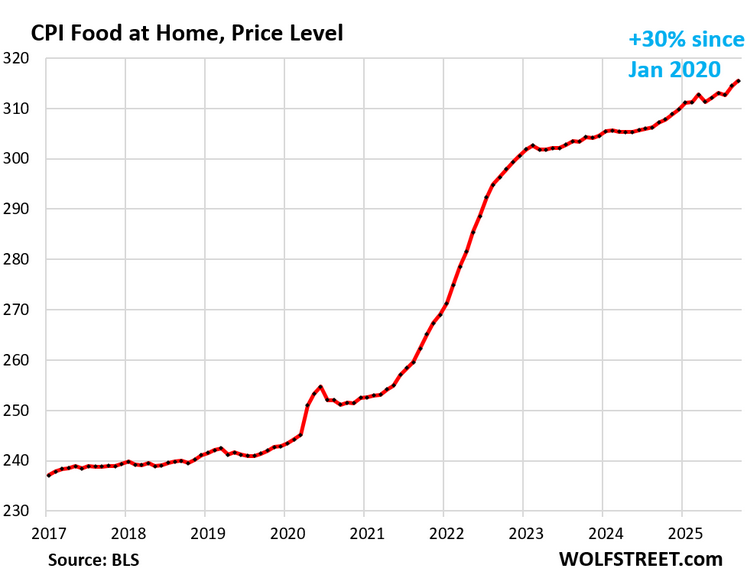
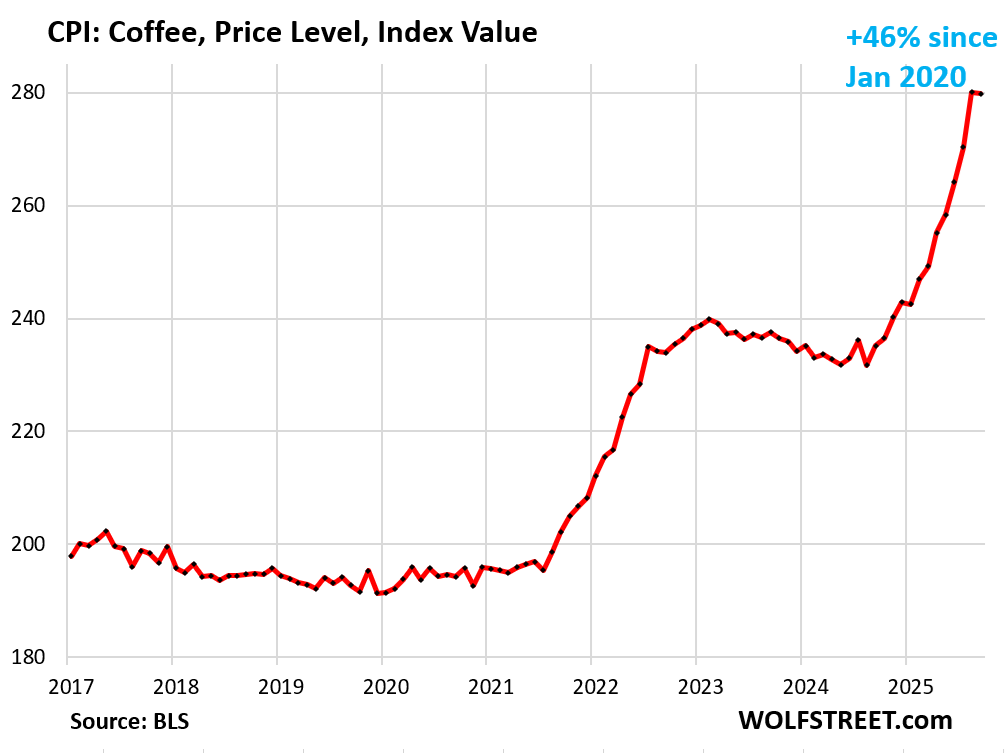
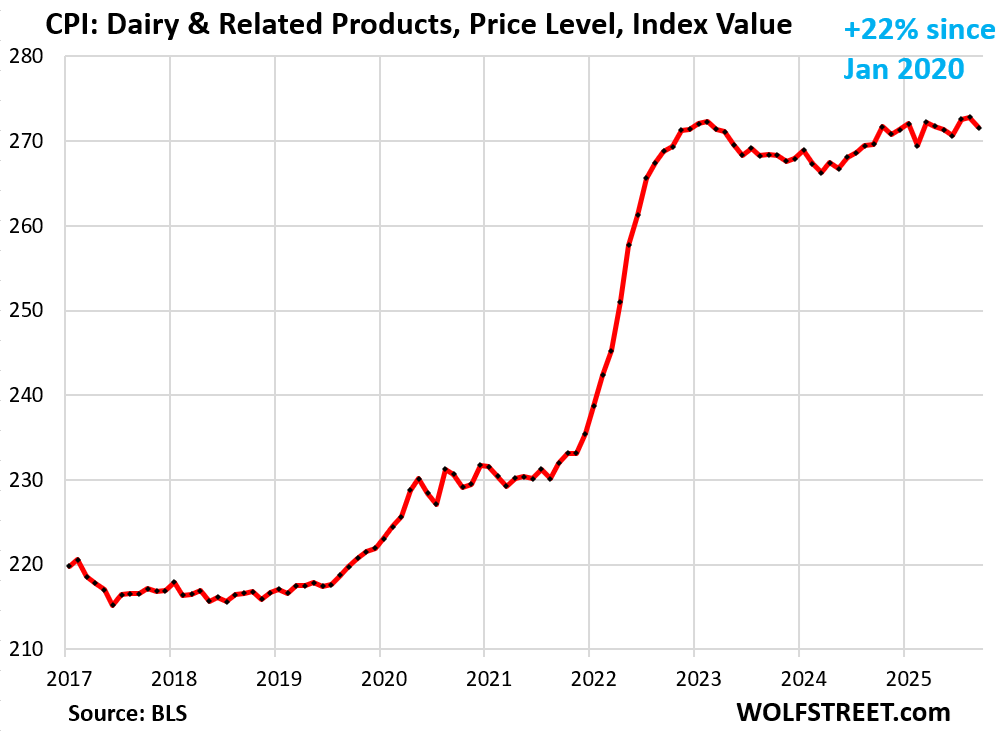
Scary Charts 01.11.26

Source: Food Inflation: The Price Spikes of Beef, Coffee, Eggs, and Dairyhttps://wolfstreet.com/2025/10/24/food-inflation-the-price-spikes-of-beef-coffee-eggs-and-dairy/

I decided I would try to collect data online from the largest supermarkets in the country, and I pretty soon realized that the numbers I was getting were two or three times higher than the official numbers for inflation. Alberto Cavallo, Professor of Business Administration, Harvard Business School – What happens when no one trusts a country’s economic datahttps://www.pbs.org/newshour/show/what-happens-when-no-one-trusts-a-countrys-economic-data

I do the food shopping in my two person half retired household and my eyeballs tell me weekly our government inflation statistics do not match reality.

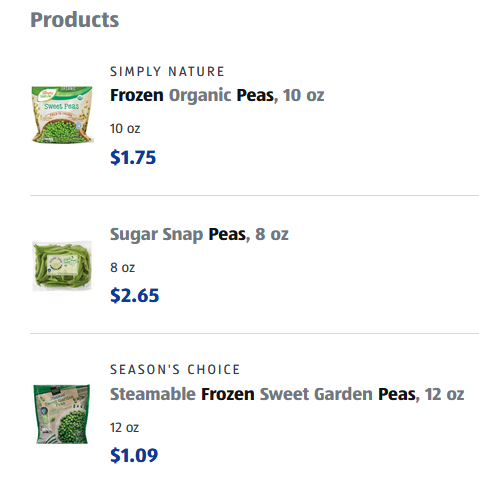
Aldi was very busy today.

Eggs Cost How Much? (Happy New Year!)

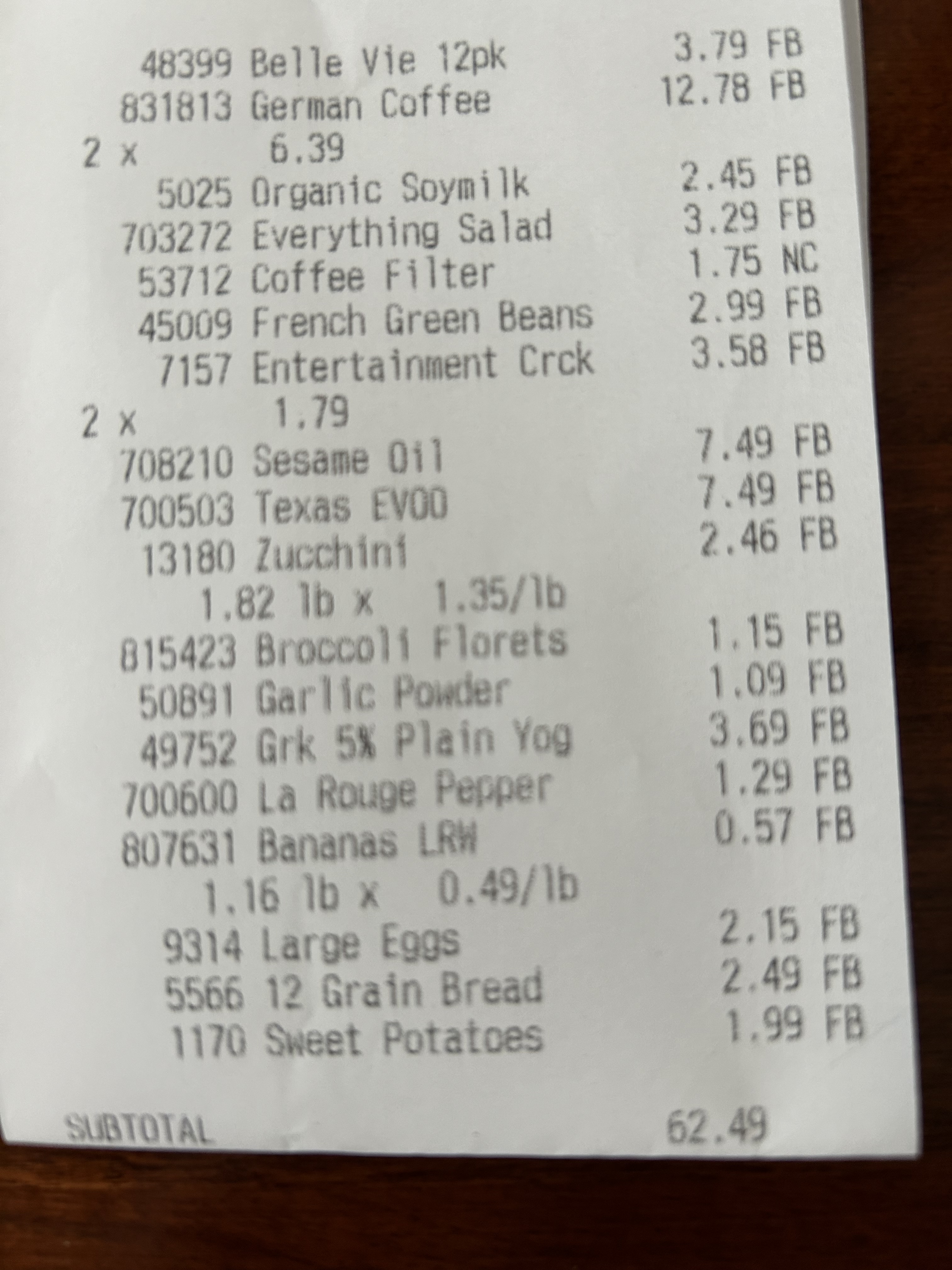
Two months ago I Just Paid $2.15 for a Dozen Eggs. Well…

According to the U.S. Department of Agriculture, egg prices in California jumped 70% from November to December, bringing the average cost for a dozen eggs to $8.97. https://abc30.com/post/bird-flu-impacting-californias-egg-supply/15728243/

I’m glad I don’t live in California.

The Last Bag of Organic Frozen Peas I Bought Will Be The Last Bag of Organic Frozen Peas I’ll Ever Buy

The false dichotomy between conventional and organic isn’t just misleading, it’s dangerous. Our constant attention on natural versus synthetic only causes fear and distrust, when in actuality, our food has never been safer.

Eating fewer fruits and vegetables due to fear of pesticides or the high price of organic food does far more harm to our health. Conventional produce has the same nutritional content and is as safe to consume as ‘organic’ produce. Most of Americans already don’t eat enough fruits and vegetables, and produce contains important nutrients, fiber, and other substances that are extremely important to our health.

From a scientific point of view, organic foods are not superior. If you want to spend more money on them, go for it. But don’t buy organic because you think it’s better for you or for the planet, because it’s not. Organic foods are not healthier…or pesticide free.https://news.immunologic.org/p/organic-foods-are-not-healthieror

I’m beginning to think I read too much. But every now and then I come across very interesting and useful information. The entire article is about a 10-15 read and is worth your time.

The amount of product labeled Organic in my freezer and pantry are minimal compared to everything else. But if the quality isn’t better or the nutritional value isn’t superior then my choice is to save money at the store whenever I can.

Nutritional quality of organic foods: a systematic reviewhttps://ajcn.nutrition.org/article/S0002-9165(23)26563-6/fulltext

Scary Charts 08.03.24

Source: Have Wages Kept Up With Inflation?https://www.statista.com/chart/32428/inflation-and-wage-growth-in-the-united-states/

How do you stretch your grocery dollars? Shop the sales and shop at different stores. I have three stores in my rotation and my shopping list determines where I shop. I’ve always been a bargain hunter.

Wander the aisles and pay attention to sell by, best by, or expiration dates. Some grocery items are not selling quickly anymore. Other items are languishing on the shelves. I found a jar of organic blueberry fruit spread for $2.41. The other week I bought two one pound packages of ground turkey reduced to $1.00 apiece. $1.00 for a pound of ground meat! The sell by dates were one day after the purchase date and the meat went straight into the freezer. Wander because you never know what items have been deeply discounted.

Stock up when you find it on sale. My favorite brand of popcorn usually costs >$3.00 a bag. I saw this popcorn this morning on sale 3 bags for $5.00. Yeah, I bought three bags.

Speaking of sales, my local wine shop was offering 12% off a half case of wine the other day and 10% off two bottles of American whiskey.

Yup, stock up.

Beans for Breakfast – 06.11.24

Lead author Yanni Papanikolaou and colleagues analyzed data from the National Health and Nutrition Examination Survey’s What We Eat in America program to study how often U.S.-based adults consume beans. In their analyses, they focused on how often Americans consumed white and red kidney beans, black beans, chickpeas, and pinto beans. The researchers observed that adults who routinely consumed these beans had improved ratios of polyunsaturated fatty acids, monounsaturated fatty acids, and saturated fatty acids compared to those who did not consume beans. Those who ate beans also consumed 30% more fruits and 20% more vegetables. Higher Intake Of Beans Linked To More Nutritious Diet https://www.forbes.com/sites/anuradhavaranasi/2024/06/11/higher-intake-of-beans-linked-to-more-nutritious-diet/

Remember Research Reveals One Simple Habit That Promotes Longevity AND Provides Extra Income in Retirement.

I’ve expanded my collection of cookbooks in search of more bean recipes.

It’s bean a lot of fun.

Rice – The Electronic Sticky Note

Most of us buy, cook, and eat it frequently, but what actually is rice? It’s a starchy cereal grain that comes from a grass species called Oryza sativa (in the scientific world, rice is referred to as Oryza). What are the Benefits of Eating Rice? (Plus, Tasty Recipe Ideas) Rice is everywhere. https://vegnews.com/vegan-health-wellness/benefits-eating-rice-tasty-recipe-ideas

The only reason why I’ve made this post part of my world famous Electronic Sticky Note series is for the Vegan Spinach, Chickpea, and Lemon Pilaf recipe.

Of course I’ll forget about this reminder in a day or two.

How Butter Beans Went From Gross to Glamorous

I was mystified. Butter beans — or lima beans, as I grew up calling them in the Midwest — are the most banal of ingredients, a boring bean relegated to the darkest corner of every home cook’s pantry. Why, then, were food influencers drowning them in luxurious sauces, crisping them up as a crouton substitute, and braising them as if they were a fine cut of meat? What the heck was going on?

Beans, broadly speaking, are having a moment. The dry bean market is expected to grow to $8.7 billion by 2028, while the canned bean industry raked in $5.65 billion in 2023 and is projected to be worth a whopping $15.5 billion by 2033, according to the market research firm Fact.MR.

How Butter Beans Went From Gross to Glamorous — https://www.eater.com/24008145/why-are-butter-beans-so-popular

Beans are cheap and nutritious. More people will be incorporating this staple into their diets because they are unable to afford the more expensive foods.

It’s not the vegan/vegetarian/let’s save the world movement. It’s basic economics.

Research Reveals One Simple Habit That Promotes Longevity AND Provides Extra Income in Retirement

Many thanks to OlRedHair at https://olredhair.wordpress.com/ for the CNN link.

Studies point to the health benefits of beans, backing up what people in blue zones have long known, Buettner said. The soluble fiber in beans can cut cholesterol and help prevent type 2 diabetes by stabilizing blood sugar. A 2001 study found eating beans four times a week cut heart disease by 22%. A 2004 study found people lived approximately eight more years for every 20-gram intake of legumes — that’s about an ounce.

Eating this food may be a reason why some people live to 100 — https://www.cnn.com/2023/06/29/health/beans-longevity-blue-zone-wellness

Beans are cheap and good for you.