
It has long been thought that meat played an important role in the diet of hunter-gatherers before the Neolithic transition. However, due to the scarcity of well-preserved human remains from Paleolithic sites, little information exists about the dietary habits of pre-agricultural human groups. A new study challenges this notion by presenting compelling isotopic evidence of a strong preference for plants among 15,000-year-old hunter-gatherers from Morocco. This is the first time a significant amount of plant consumption has been measured for a pre-agricultural population, shedding new light on the dietary practices of ancient human societies. More plants on the menu of ancient hunter-gatherers — https://www.mpg.de/21865602/more-plants-on-the-menu-of-ancient-hunters-gatherers
Memo to My Younger Self
Tommy Lundberg, an exercise researcher at the Karolinska Institute in Solna, Sweden, and the author of The Physiology of Resistance Training, says that strength training is far more important than most people realize.
“You get improved glucose control, especially if you have Type 2 diabetes,” he says. “You feel better —which is a very important effect, as it can reduce stress levels — and you typically get better sleep. As you age, it helps you function better so you can carry out your daily activities for a longer period of time. It also helps reduce your risk of falls.” https://www.newsmax.com/health/health-news/strength-training-resistance-longevity/2024/01/24/id/1150856/
Quote for Today – 05.24.24
“We’re not born with unlimited choices. We can’t be anything we want to be. We come into this world with a specific, individual destiny. We have a job to do, a calling to enact, a self to become. We are who we are from the cradle, and we’re stuck with it. Our job in this lifetime is not to shape ourselves into some ideal we imagine we ought to be, but to find out who we already are and become it.”
Steven Pressfield
Still Not a Vegan?
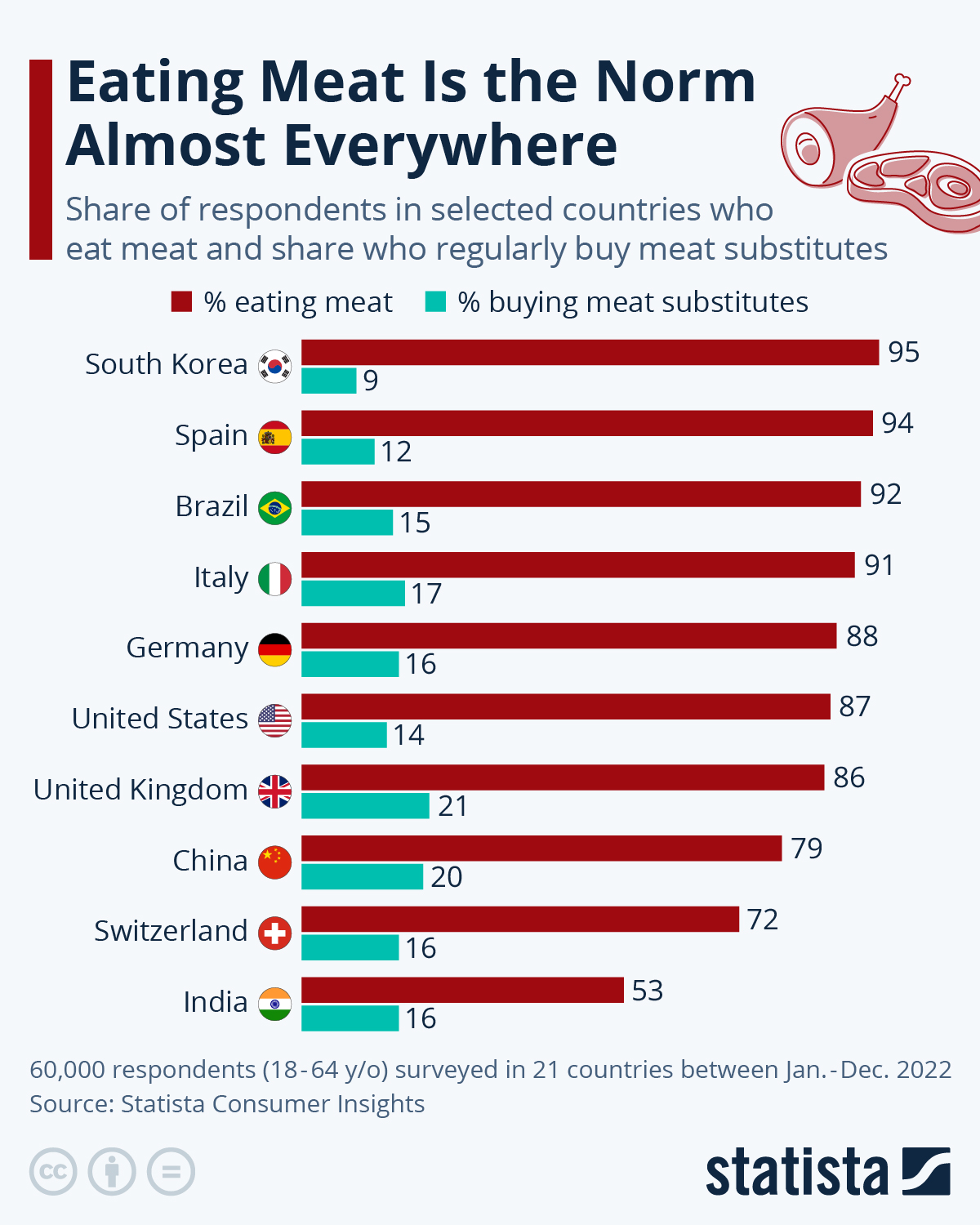
On average, 86 percent of people surveyed for Statista’s Consumer Insights in 21 countries said that their diet contained meat – highlighting that despite the trend around meat substitutes and plant-based products, eating meat remains the norm almost everywhere in the world. To satisfy the world’s hunger for meat, 340 million tons of it were produced globally in 2021. Because meat consumption typically increases as countries grow wealthier, that number has been rising.
Eating Meat Is the Norm Almost Everywhere — https://www.statista.com/chart/24899/meat-consumption-by-country/
I had a vegan meal while posting this. Just sayin’.
Can Someone Please Explain This To Me?

Lessons I Wish I Had Learned From a Lifetime of Cooking #4
How to Use Chopsticks – the article https://thewoksoflife.com/how-to-use-chopsticks/
The video:
Lesson #4. You can always get better at something.
Back in my East Coast days I would take a bunch of guys into NY Chinatown for some authentic Chinese food. The restaurant was a classic hole in the wall, one of the places that didn’t cater to non-Chinese diners. All the menus were in Chinese and the family banquet style menus were posted near the ceiling on the wall. The group would get seated, tea was served, and I would point to the menu on the wall for our table. Sometimes I pointed to a menu I thought I had ordered in the past and the food was different from the last visit. Didn’t matter. It was all good.
My friends all got forks, spoons, and knives. The waiter would remove my silverware and return with a pair of chopsticks and one of those awkward soup spoons. I always had to ask for a fork and regular spoon because I was really bad at using chopsticks.
I still can’t use chopsticks very well. Too bad we didn’t have the internet or YouTube back then. At least I now have instructions and a video to watch.
Time to practice!
More Cranberries
Cranberry is associated with multiple health benefits, which are mostly attributed to its high content of (poly)phenols, particularly flavan-3-ols. However, clinical trials attempting to demonstrate these positive effects have yielded heterogeneous results, partly due to the high inter-individual variability associated with gut microbiota interaction with these molecules. In fact, several studies have demonstrated the ability of these molecules to modulate the gut microbiota in animal and in vitro models, but there is a scarcity of information in human subjects. In addition, it has been recently reported that cranberry also contains high concentrations of oligosaccharides, which could contribute to its bioactivity. Hence, the aim of this study was to fully characterize the (poly)phenolic and oligosaccharidic contents of a commercially available cranberry extract and evaluate its capacity to positively modulate the gut microbiota of 28 human subjects. After only four days, the (poly)phenols and oligosaccharides-rich cranberry extract, induced a strong bifidogenic effect, along with an increase in the abundance of several butyrate-producing bacteria, such as Clostridium and Anaerobutyricum. Plasmatic and fecal short-chain fatty acids profiles were also altered by the cranberry extract with a decrease in acetate ratio and an increase in butyrate ratio. Finally, to characterize the inter-individual variability, we stratified the participants according to the alterations observed in the fecal microbiota following supplementation. Interestingly, individuals having a microbiota characterized by the presence of Prevotella benefited from an increase in Faecalibacterium with the cranberry extract supplementation.
Short term supplementation with cranberry extract modulates gut microbiota in human and displays a bifidogenic effect — https://www.nature.com/articles/s41522-024-00493-w
The further I got into reading this study the more I realized it was way over my pay grade.
I’ll sumarize – eat more cranberries because they’re good for you.
My earlier post Cranberries was much easier to understand.
 garyskitchen.net