
Eating is getting expensive – https://vegnews.com/eggs-foods-at-risk
Lessons Learned From a Lifetime of Cooking #9
Celery leaves. I always tossed them out until The Boss informed me she doesn’t like big chunks of celery in dishes I make that use celery for an ingredient. I recently discovered you can use celery leaves like a fresh herb, finely chopped and added to your creation in lieu of big chunks of celery. So far I haven’t gotten any complaints about the tiny green stuff floating in the soup.
10 Ways To Use Celery Leaves In The Kitchen.
Read More: https://www.tastingtable.com/1572645/uses-celery-leaves/
Memo to Self – instead of buying celery with less leaves buy celery with more leaves, especially bunches with dark green leaves which have a more intense flavor than the stalks.
Trouble in Paradise 2024 (it’s Weight Gain Season again)
I’ve been posting this chart for several years around the Holiday Season. The source has been attributed to the New England Journal of Medicine. but I could never find the original source article.

Obesity prevalence among older Americans has increased at an alarming rate. In a single generation—between 1988-1994 and 2015-2018—the share of U.S. adults ages 65 and older with obesity nearly doubled, increasing from 22% to 40%.13 – Fact Sheet: Aging in the United States https://www.prb.org/resources/fact-sheet-aging-in-the-united-states/
At the beginning of every month I record my weight in my personal journal. I started November at 176.2. I managed to survive two birthdays, one homemade Eddie’s Carrot Sheet Cake, a few cupcakes, and the recurring annual threat of Halloween candy. Two more months to go.
My doctor says I worry too much about gaining weight. But she’s a hell of lot younger so what does she really know about my aging metabolism?

Remember this from two years ago? Well the bakers showed up again this Thanksgiving.

It was so good we did it again.
This year’s Thanksgiving was wonderful and memorable in a number of ways. The first blessing of the season was I didn’t have to drive. Let’s just say The Boss wouldn’t let me drive.

The next blessing was spending time with relatives we had not seen in several years. We shared stories, made fun of one another and had a great time. Thanksgiving was different this year; neither of our kids and their families were with us. So we had to borrow a Tiny Human for the occasion.
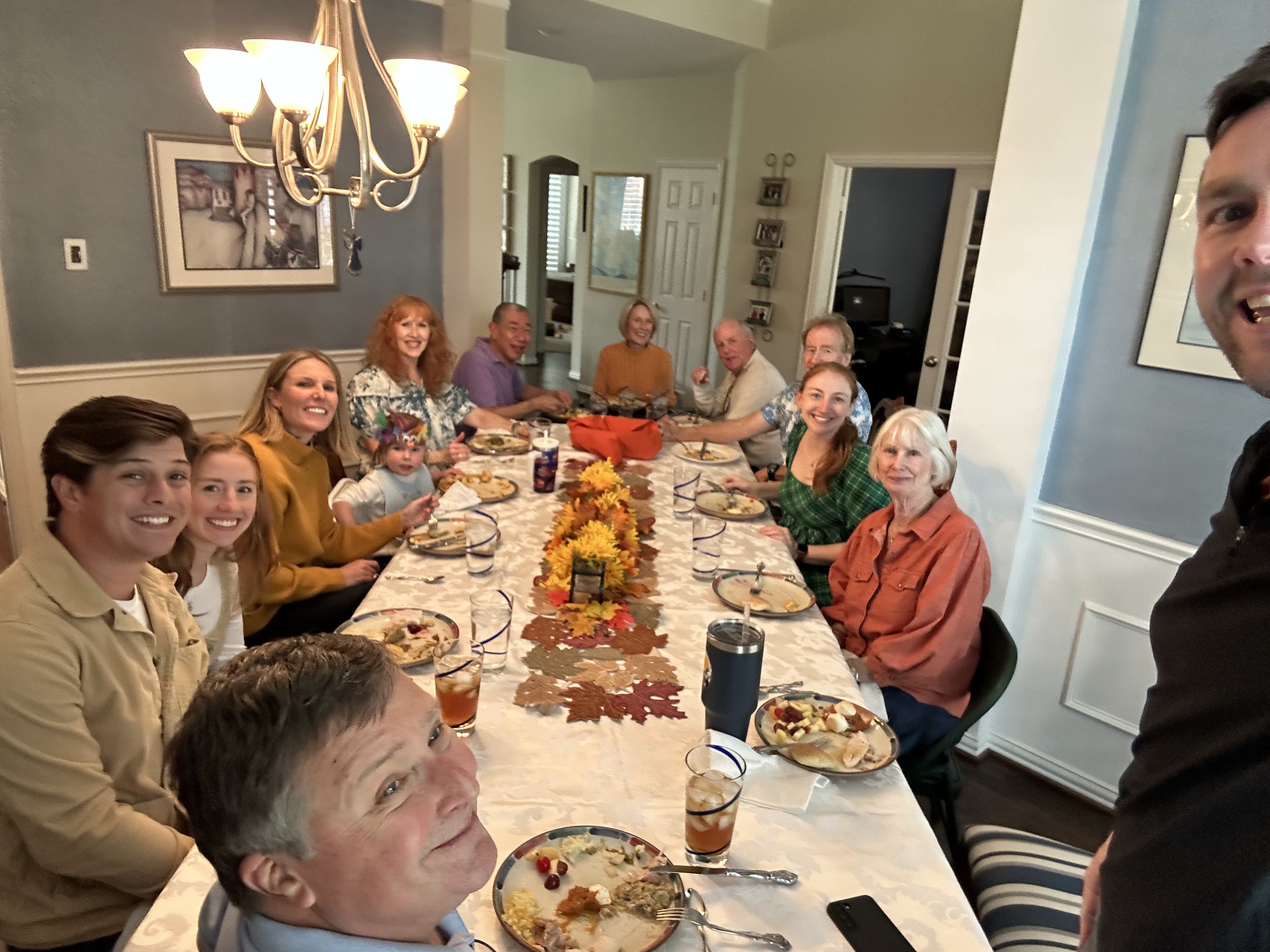
One Tiny Human, a lot more aunts, uncles, parents and grandparents.
The best blessing was I managed to gain just two pounds from this year’s Thanksgiving food binge.
Happy Thanksgiving to all. Stay well. Stay slim.
Lessons Learned From a Lifetime of Cooking #8
I am very, very bad at cooking tofu.
Remember Baked BBQ Tofu? Well I recently discovered I can’t even fry tofu properly.
Memo to Self – order out for tofu.
Eat the Rainbow (except for this stuff)
Re-posted without the usual snarky comment.
The Last Bag of Organic Frozen Peas I Bought Will Be The Last Bag of Organic Frozen Peas I’ll Ever Buy
The false dichotomy between conventional and organic isn’t just misleading, it’s dangerous. Our constant attention on natural versus synthetic only causes fear and distrust, when in actuality, our food has never been safer.
Eating fewer fruits and vegetables due to fear of pesticides or the high price of organic food does far more harm to our health. Conventional produce has the same nutritional content and is as safe to consume as ‘organic’ produce. Most of Americans already don’t eat enough fruits and vegetables, and produce contains important nutrients, fiber, and other substances that are extremely important to our health.
From a scientific point of view, organic foods are not superior. If you want to spend more money on them, go for it. But don’t buy organic because you think it’s better for you or for the planet, because it’s not. Organic foods are not healthier…or pesticide free. — https://news.immunologic.org/p/organic-foods-are-not-healthieror
I’m beginning to think I read too much. But every now and then I come across very interesting and useful information. The entire article is about a 10-15 read and is worth your time.
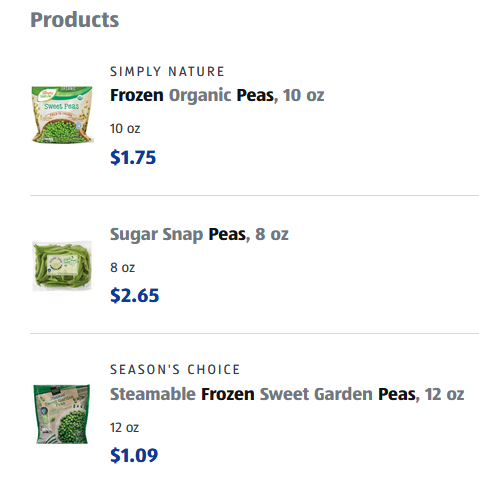
The amount of product labeled Organic in my freezer and pantry are minimal compared to everything else. But if the quality isn’t better or the nutritional value isn’t superior then my choice is to save money at the store whenever I can.
Nutritional quality of organic foods: a systematic review – https://ajcn.nutrition.org/article/S0002-9165(23)26563-6/fulltext
Scary Charts – 10.10.24 (and the answer to the question is NO)
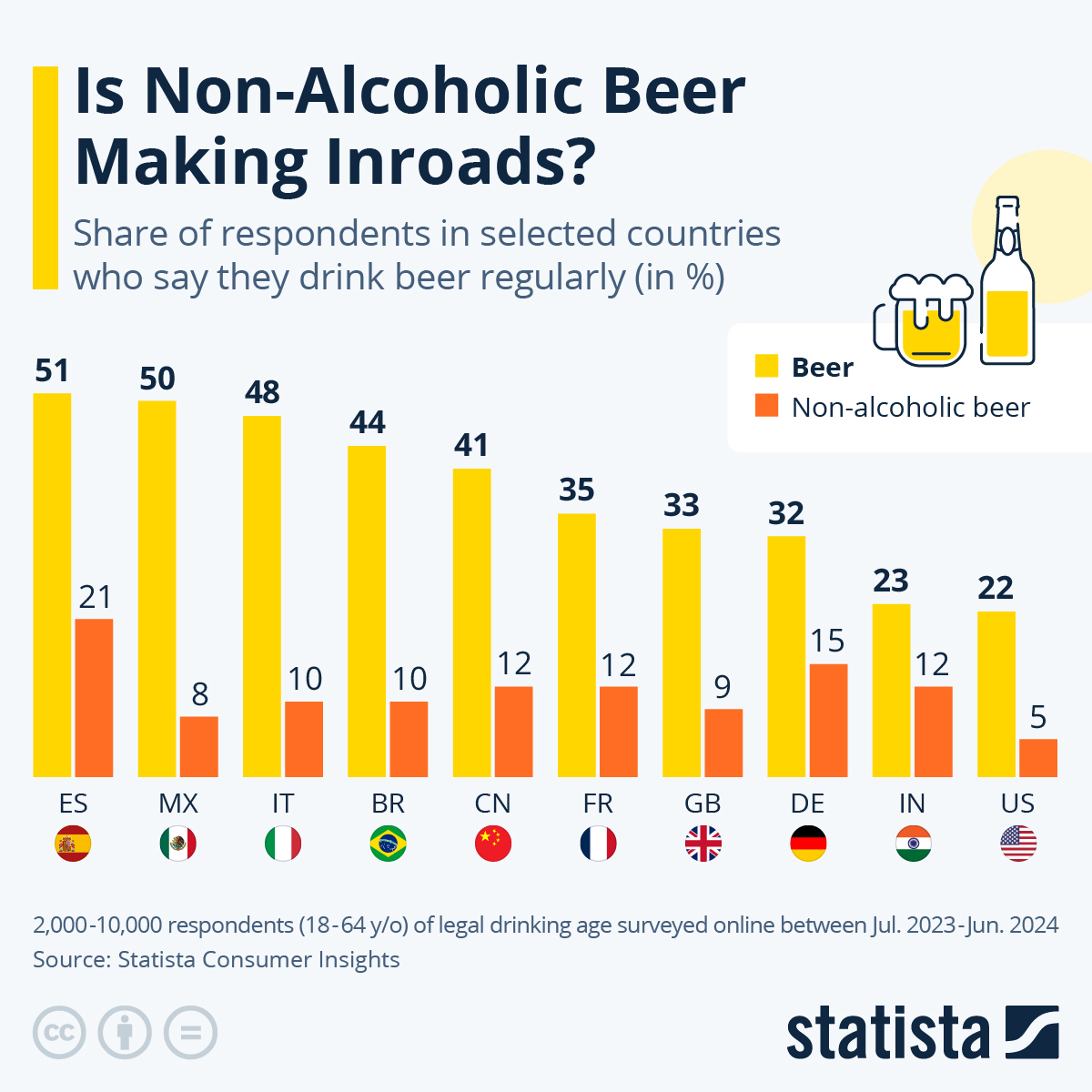
Who’s Drinking (Non-Alcoholic) Beer? – https://www.statista.com/chart/33210/regular-beer-drinkers-survey/
Anyone who knows me personally or has followed my blog posts know I have a fondness for beer. The problem is empty non-nutritional calories. I just learned about Persistent Metabolic Adaptation so I thought why not try a new strategy? Yup, I’m testing non-alcoholic beers. Sample size is small, researcher bias definitely exists, so don’t try to extrapolate my findings to a larger population of non-alcoholic beers. So, straight to the research.
Coors Edge – somewhat palatable, tastes somewhat like beer.
Heineken 0.0 – odd taste, worse aftertaste almost like a spoiled real Heineken.
I’m guessing whatever the Spaniards are drinking must taste better than the zero taste, zero alcohol brews we have in the US.
Lessons Learned From a Lifetime of Cooking #7
Sunday 9/22
My Mom loved hard boiled eggs. But beyond the egg, what she loved was her hot sauce. Tabasco, the one of a kind hot sauce from Avery Island, Louisiana. Mom always ate her boiled eggs with Tabasco and we’re not talking a few drops here and there. She would cut the boiled egg in half and hit that thing with so much Tabasco you literally could not see any yellow.
I thought this was disgusting.
I was 25 years young when I was introduced to the strange land known as Texas. What do you mean these chips are not potato chips? What’s that tiny bowl of red stuff? I was and still am a Jersey Boy from the mean streets of Newark. Seriously, people eat chips made from corn dipped in this red stuff?
It was not love at first bite. But like many other things in life I learned to love Texas and all things about the Lone Star State. This Jersey Boy met and married a Dallas girl and we created two more Texans. I acquired my desire for Thai food in Texas which then led me to other forms of spicy heat. The years sped by and when the Sriracha craze hit I never got on that train. I did keep a small bottle of the Huy Fong chili garlic sauce in the fridge which became my go to sauce when I needed to heat up my mild bland homemade chili made specifically not spicy for the someone else I live with.

My chili garlic sauce had to get tossed because the expiration date was years ago. I guess I never used this sauce as much as I thought. Today is the first day of Fall and chili season grows near. I needed a replacement hot sauce. The Tabasco, cayenne pepper, red pepper flakes, some cheap Mexican hot sauce and the omnipresent jar of medium salsa were just not going to work for me.
Then suddenly (Devine Intervention?) this hit the grocery shelves.

Thanks Mom. I hope you are enjoying your hard boiled eggs wherever you are.
Cooking For One is Not Fun (unless you’re making a Sweet Potato Chicken Quesadilla)
Cooking For One is Not Fun is still not fun even after yesterday’s mini-rant. The plan was simple: go to the store, buy two rotisserie chickens, rip the meat off the bones and make a quick simple dinner. Well I didn’t fix any dinner and now I have a tub full of cooked chicken. After a hearty breakfast of pancakes, peanut butter and banana I started thinking about lunch.
I found two small sweet potatoes, tortillas and Monterrey Jack cheese.
Quesadilla time!
- 1 medium sweet potato (or two small ones)
- cooked rotisserie chicken, small dice
- Salt, pepper, chill powder, onion powder, garlic powder, oregano, cumin
- olive oil, butter or margarine
- tortillas
- Sharp cheddar cheese and or Monterrey Jack
- Sriracha (be careful with this)
- Preheat oven to 375 degrees F. Line a baking sheet with aluminum foil. Lightly grease with some olive oil.
- Scrub the dirt off the sweet potatoes and split them lengthwise. Place cut side down on the greased aluminum foil covered baking sheet and bake. (small to medium 30-45 minutes, large will take an hour or so). When done, remove from oven and allow to cool.
- Scoop potatoes into a mixing bowl. See the list of spices? Add a pinch of each. The actual amount depends upon how much potato you’re working with. Mix well and set aside.
- Heat a griddle or large pan on the stove, medium flame.
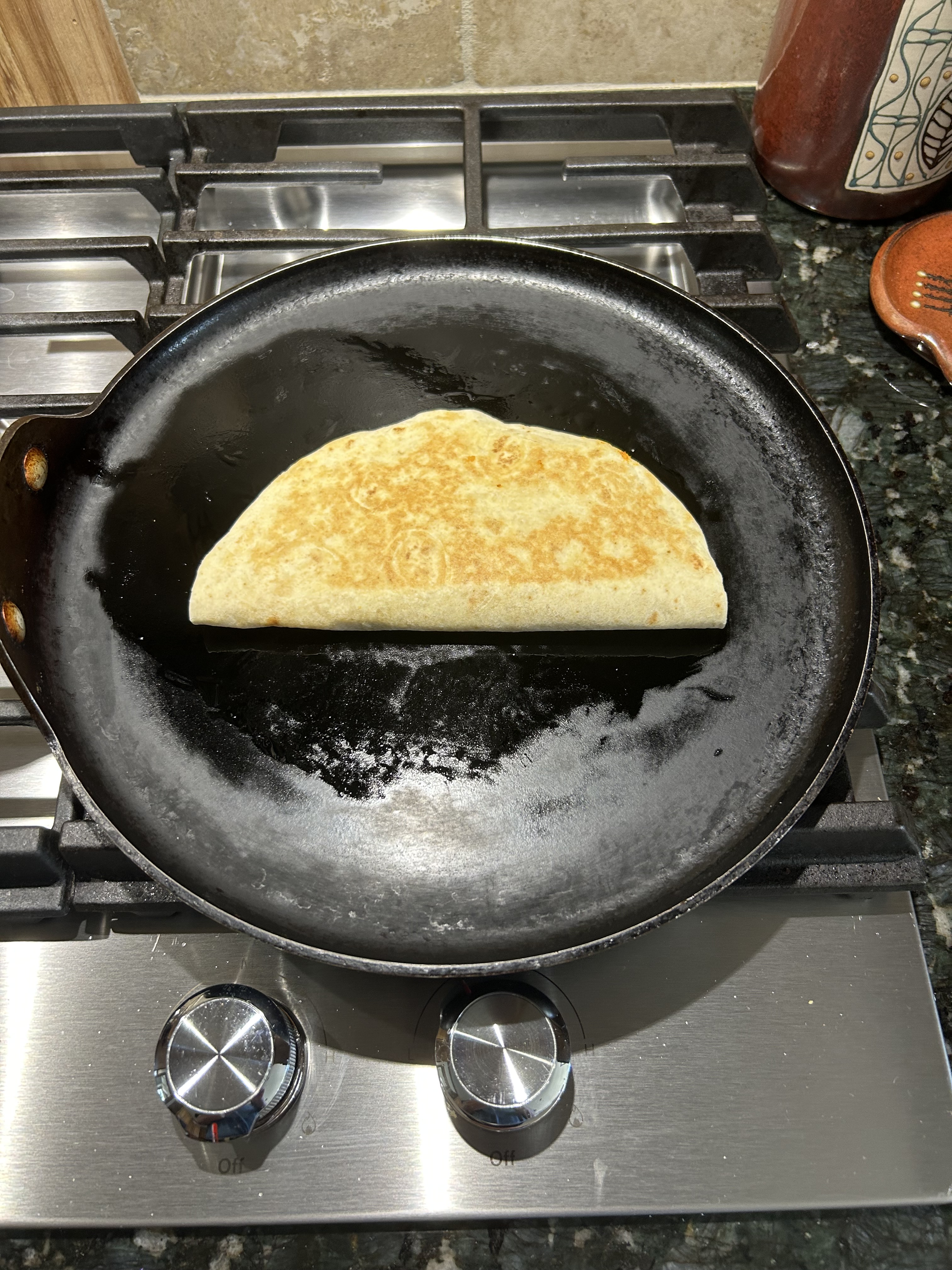
- Butter or margarine one side of a tortilla. If using butter, add some olive oil to the griddle because butter burns. Tortilla buttered side down on the griddle. Fill one half side with potato and dot with chicken and cheese. Flip the other half over so it looks like a quesadilla. Brown on both sides. It’s done when the cheese is melted and the filling is warm.
- Repeat. Eat.
- Bet you thought I forgot the Sriracha. If you like spicy go ahead and add to your potato mixture along with the rest of the spices. Or use Sriracha as a drizzle or dipping sauce. Just remember if you add this to the potatoes before grilling I assume zero responsibility for the searing burn in your throat.
- Actually, go ahead and use your favorite hot sauce.

Yeah, the picture above is cheating. Here’s the real shot.
The Bottom Line
Tasty. But I said it before and I’ll say it again. Cooking For One is Not Fun and this was a lot of work to make one quesadilla. At least I’ve worked out the spice combo and the flavors are fine. I did end up mixing a few dashes of Sriracha into the potato. Cooking for one needs to be quick, simple, filling, and nutritious. This quesadilla did not meet the “quick” criteria.
In the future consider the following:
- Bake and season the potatoes the night before to allow the flavors to marry and to save time when actually making this quesadilla.
- Make more than one quesadilla. Trust me on this.
- Tabasco brand Sriracha (an unpaid endorsement).
- Buy and debone your chicken ahead of time.
This post is #9 in my One Rotisserie Chicken, 50 Meals – The Concept series that I started 12 years ago. At this pace I won’t live long enough to finish the series. At least no one pays me for my content. Maybe I’ll change the title to One Rotisserie Chicken, 10 Meals and declare this series done.
Seed Oils – Updated 08.24.24
If you consume social media, you may have heard: Seed oils are terrible for your health–even toxic! Cooking oils derived from seeds cause everything from heart disease to inflammation to fatigue to bad skin–according to a certain subset of Internet influencers. Yet contrary to the posts demonizing the common ingredients, a bevy of scientific research disagrees…
And broadly, the best path to a healthy diet is probably what you’d expect. A diet rich in fruits and vegetables, with whole grains and lots of fiber, is best, say Calder and Johnson. “It’s what your mother told you,” Johnson adds. Moving more and eating slightly less overall, are probably also good ideas for most Americans, notes Harris. “It’s not sexy, but that’s the way it is.” What science actually says about seed oils — https://www.popsci.com/health/are-seed-oils-bad-for-you/
Update
The American Heart Association supports the inclusion of omega-6 fatty acids as part of a healthy diet. There’s no reason to avoid seed oils and plenty of reasons to eat them — https://www.heart.org/en/news/2024/08/20/theres-no-reason-to-avoid-seed-oils-and-plenty-of-reasons-to-eat-them
You’re welcome.
 garyskitchen.net