There’s Another Blue Zone in the US

“It’s really what they’re not doing. They’re not doing anything consciously, and there’s where we get it wrong,” Buettner said. “We think we can resolve to get on the right diet, the right exercise program, supplement plan, superfoods, and get healthier. But it never works.”

Buettner said that the “superagers” are often walking outside, having spontaneous conversations with the people they bump into, having a smaller dinner, and eating mostly a whole food, plant-centric diet.

A look inside the United States’ first-ever certified “Blue Zone” located in Minnesota — https://foodfactsandfads.com/2024/02/04/6306/

Remember, Eat More Plants.

Also Research Reveals One Simple Habit That Promotes Longevity AND Provides Extra Income in Retirement

More Coffee Please

People have been drinking coffee since 15th century, but the past few years have seen a flood of new studies suggesting that drinking coffee (copious amounts of coffee in many cases) improves longevity and brain function, while also combating some of the most common and feared adult health issues.

Neuroscience Says Drinking Coffee Like This Boosts Brain Function and Makes You Live Longerhttps://www.inc.com/bill-murphy-jr/neuroscience-says-drinking-coffee-like-this-boosts-brain-function-makes-you-live-longer.html

The article contains links to several studies on the benefits of drinking coffee.

Don’t Forget to Take Your Vitamins

Researchers tested the effects of a daily multivitamin on cognitive changes in a study of 573 participants with in-person visits in the COSMOS trial. The researchers also conducted a meta-analysis among over 5,000 non-overlapping participants across the three separate cognition studies within the COSMOS trial. Results showed a statistically significant benefit for cognition among participants taking the multi-vitamin compared to placebo, suggesting that a multi-vitamin could help prevent memory loss and slow cognitive aging among older adults.

Mass General Brigham. “Third major study finds evidence that daily multivitamin supplements improve memory and slow cognitive aging in older adults.” ScienceDaily – https://www.sciencedaily.com/releases/2024/01/240118122110.htm (accessed January 19, 2024).

I forgot to take my vitamins today until this article caught my eye.

How To Reduce Your Risk of Developing DM2 (type 2 diabetes)

Photo by mali maeder on Pexels.com

Replacing one serving of red meat a day with a serving of plant-based protein sources like nuts or legumes decreased the risk of type 2 diabetes by 30%, and substituting a serving of red meat for dairy decreased the risk by 22%.

More Than One Red Meat Serving A Week Can Increase Diabetes Risk — https://www.forbes.com/sites/ariannajohnson/2023/10/19/more-than-one-red-meat-serving-a-week-can-increase-diabetes-risk-study-finds/

The Forbes article has links to other research studies on meat consumption and health.

Link to the Harvard press release — Red meat consumption associated with increased type 2 diabetes risk — https://www.hsph.harvard.edu/news/press-releases/red-meat-consumption-associated-with-increased-type-2-diabetes-risk/

The study featured in the articles above was published on Thursday, October 19, in The American Journal of Clinical Nutrition.

My Personal Opinion

If you eat meat, eat less. If you don’t eat meat, consider the occasional meal with meat for its nutritional benefits. My diet is approximately 75% meat-free, I do not have diabetes.

Eat This Way – PURE Study

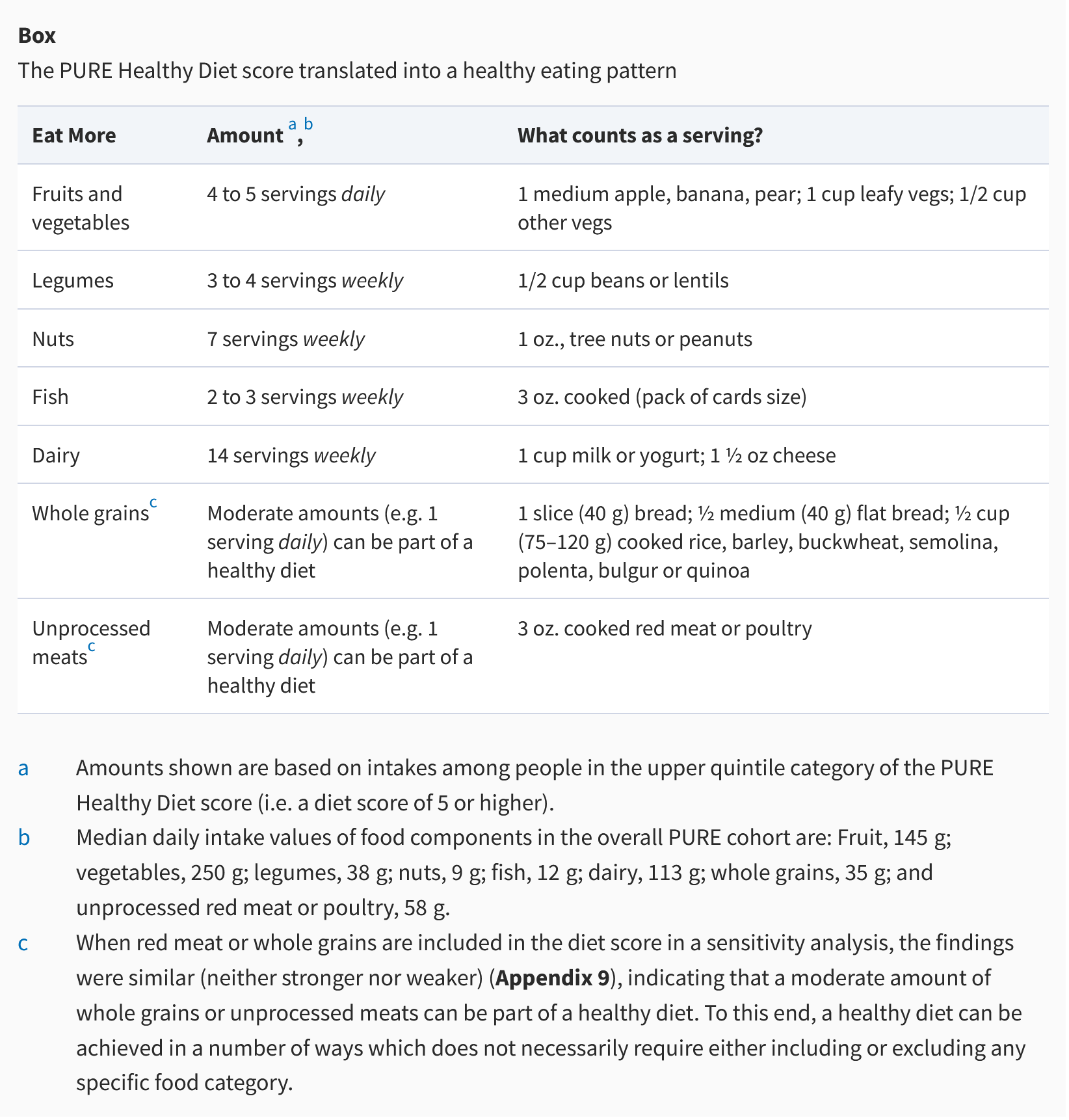
A diet comprised of higher amounts of fruit, vegetables, nuts, legumes, fish, and whole-fat dairy is associated with lower CVD and mortality in all world regions, especially in countries with lower income where consumption of these foods is low.

Our findings suggest that globally the key to a healthy diet is probably one that includes diverse natural foods in moderation, rather than restricting intake to a small number of food categories.

Diet, cardiovascular disease, and mortality in 80 countries — https://academic.oup.com/eurheartj/advance-article/doi/10.1093/eurheartj/ehad269/7192512

Presented without the usual snarky comment about some of my dietary choices like whole-fat Greek yogurt and full fat cheeses.

Time to make lunch. Spinach quesadillas with whole-fat cheddar cheese.

DO NOT EAT (crickets for iron)

Iron absorption from house crickets and fortified maize porridge with crickets is low, which may be explained by the presence of chitin and other inhibitors in the cricket biomass.

Absorption of iron from edible house crickets: a randomized crossover stable-isotope study in humans — The American Journal of Clinical Nutrition, Volume 116, Issue 4, October 2022, Pages 1146–1156, https://doi.org/10.1093/ajcn/nqac223

Always remember to eat a well balanced diet.

And find other dietary sources for iron besides crickets.

Research Reveals One Simple Habit That Promotes Longevity AND Provides Extra Income in Retirement

Many thanks to OlRedHair at https://olredhair.wordpress.com/ for the CNN link.

Studies point to the health benefits of beans, backing up what people in blue zones have long known, Buettner said. The soluble fiber in beans can cut cholesterol and help prevent type 2 diabetes by stabilizing blood sugar. A 2001 study found eating beans four times a week cut heart disease by 22%. A 2004 study found people lived approximately eight more years for every 20-gram intake of legumes — that’s about an ounce.

Eating this food may be a reason why some people live to 100 — https://www.cnn.com/2023/06/29/health/beans-longevity-blue-zone-wellness

Beans are cheap and good for you.

This is Nuts!

Additional Adventist Health Study findings validated the relationship between eating nuts and whole wheat bread and experiencing a reduced risk for coronary heart disease (CHD). These findings were published in a research article by Dr. Fraser and his colleagues to the Archives of Internal Medicine in 1992. The findings attracted substantial media attention.

The research reported that eating nuts one to four times a week:

Lowered the risk of nonfatal heart attack by 74 percent.

Lowered the risk of fatal coronary heart disease by 73 percent.

Findings for Nuts — https://adventisthealthstudy.org/studies/AHS-1/findings-nuts

I hope peanut butter has the same protective properties. Well, not exactly.

Our findings suggest potential benefits of higher nut and peanut butter consumption in lowering risk of type 2 diabetes in women. To avoid increasing caloric intake, regular nut consumption can be recommended as a replacement for consumption of refined grain products or red or processed meats.

Nut and Peanut Butter Consumption and Risk of Type 2 Diabetes in Women — https://jamanetwork.com/journals/jama/article-abstract/195554

The Boss eats nuts every day in her yogurt and fruit breakfast. She eats the same breakfast every single day. I used to poke fun at her for this dietary pattern but I no longer will.